

Dental, vision and paid family and medical leave land right behind medical insurance in terms of desirability for American workers.
It’s obvious that American workers want, and need, affordable and comprehensive healthcare coverage. But more workers than ever before are also thinking about ancillary benefits that can save them money every year, according to a recent workforce benefits survey by EY and LIMRA (the Life Insurance Marketing and Research Association).
Many are also looking for paid family and medical leave, which is now required in roughly one-quarter of all states.
Employee Benefits by the Numbers
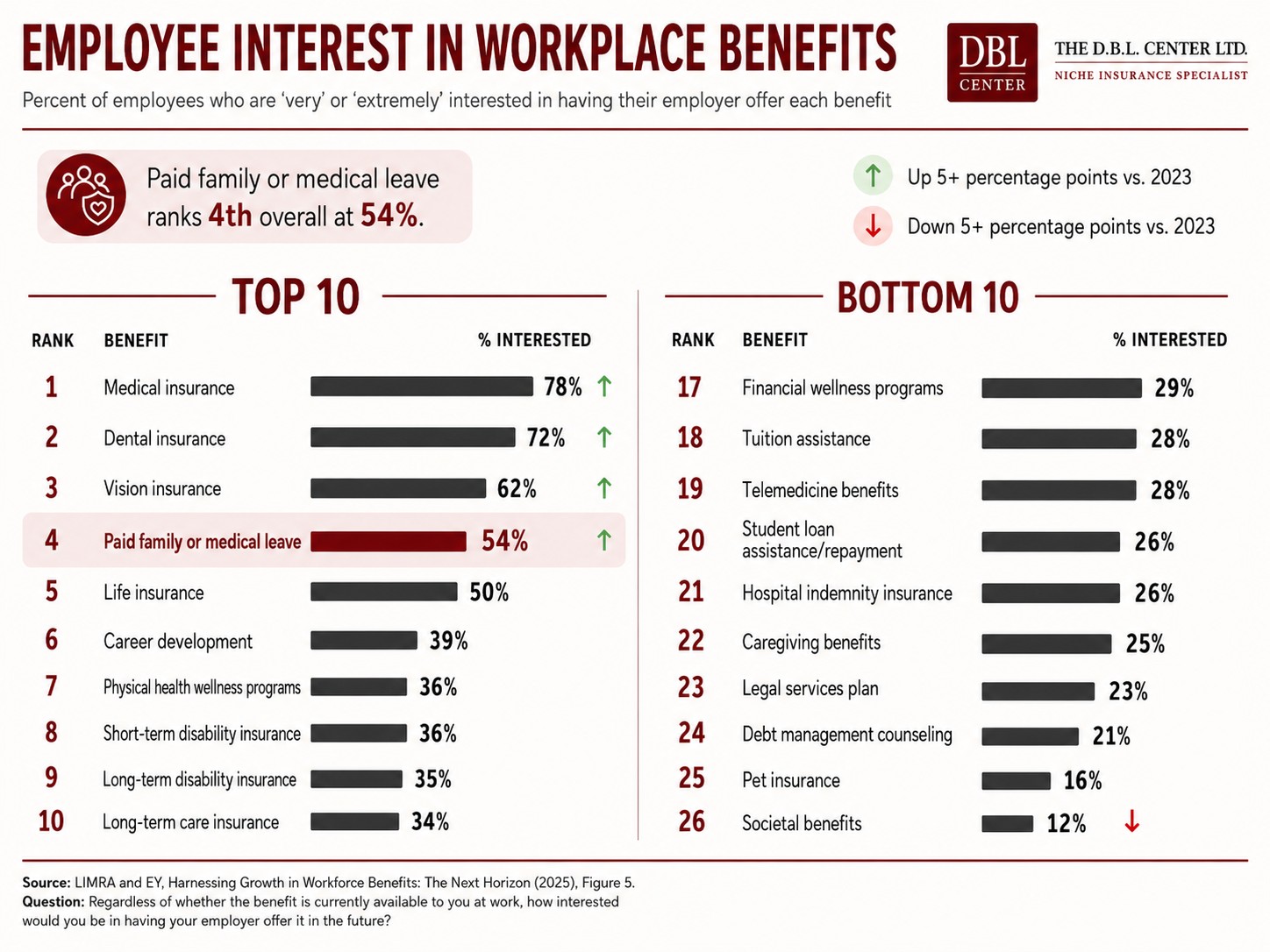
More than half of employees (54%) said they would be interested in having their employer offer paid family and medical leave. PFML is in nearly equal demand across Gen Z (54%), Millennials (57%), and Gen X (54%). Boomers are the outlier, with only 43% showing interest in PFML.

Across generations, a desire for PFML falls right behind dental insurance (72%) and vision coverage (62%). Between 2023 and last year, all three benefits showed more than a 5% increase in desirability, indicating a trend that employees are seeking ancillary benefits that fit their lifestyle and can save them money.
Employers also believe their workers will have interest in dental, vision, and paid family and medical leave within the next five years. The survey showed that 79% of employers believe their workers will have interest in dental insurance, up by more than 5% from 2023. Nearly three-quarters (74%) believe their workers will want vision insurance in five years, also up more than 5%.
The percentage of those requesting paid family and medical leave hasn’t increased substantially, which shows there has been strong desire historically, especially as more states introduced mandated programs.
Paid family and medical leave is now considered part of the “core four” in benefits, which encompasses medical, dental, and vision insurance. Meanwhile, group life insurance sits in the number five spot, still important but below PFML.
A Paradigm Shift Toward PFML
As Gen Z (born between 1997 and 2012) takes over the workforce, outnumbering baby boomers, the oldest of Gen Z are already moving into management positions. At the same time, this demographic is also starting families. Ideals surrounding employee benefits are changing as a result.
Gen Z has never lived in a world where paid family leave and bonding leave wasn’t a reality.
“They’ve grown up with FMLA for job protection and employer paid leave programs and expect it as a right, not a nice-to-have that their parents may not have had 20 years ago,” said Gina Rutledge, DBL Center assistant vice president – paid family and medical leave solutions.
Younger generations highly value work-life balance and aren’t afraid to ask for wellness benefits that will enhance their productivity and mental health. “It’s not just that people asking for these benefits are younger,” Rutledge said. “The people approving the leave are younger, with the mindset that [bonding] leave is a reality.”
Workers Want Broad-Based Benefits, Not Niche Programs
A deeper look at the trends shows that employees want broad-based benefits that protect their health and income.
It’s the classic, “Your money, your life,” mantra indicating what’s most important to people.
The outlier in the top 10 employee benefits on the list would appear to be “career development,” as it’s not related to income and job protection or personal wellness.
But career development programs have broad-based applications for nearly anyone in a company or organization, earning it a spot in the top 10.
Benefits on the bottom of the list, with fewer than ¼ of employees showing interest, were: “societal benefits,” pet insurance, debt management counseling, and legal services plans. These are niche benefits that only appeal to smaller demographics within the workplace.
Compliance Is Just the Beginning
As more states move toward mandating Paid Family and Medical Leave (PFML), employers are seeing a clear shift in how candidates evaluate benefits packages. The survey data underscores the importance of comprehensive insurance coverage that includes mandatory and ancillary benefits. Compliance is crucial for employers to avoid fines and legal red tape, but a solid benefits plan goes beyond compliance to fill the needs of your entire workforce.
This trend is reflected in what we’re seeing at The DBL Center as well. Today’s workforce increasingly views offerings like dental and vision coverage not as optional perks, but as meaningful value-adds when deciding whether to join—or remain with—an organization.
At the same time, a persistent talent shortage is pushing employers to rethink their benefits strategies, using comprehensive packages as a key lever to attract and retain skilled employees.More than ever, clients are incorporating PFML alongside dental, vision, life, and other supplemental benefits into their RFPs.
Let The DBL Center help you by performing a risks gap analysis for your clients, ensure you’re in compliance with state laws, and deliver the benefits your clients need and want. We can help you write PFML in a variety of states through a private plan and roll the savings into ancillary benefits that help keep workers secure and happy.
Reach out for a quote today.