


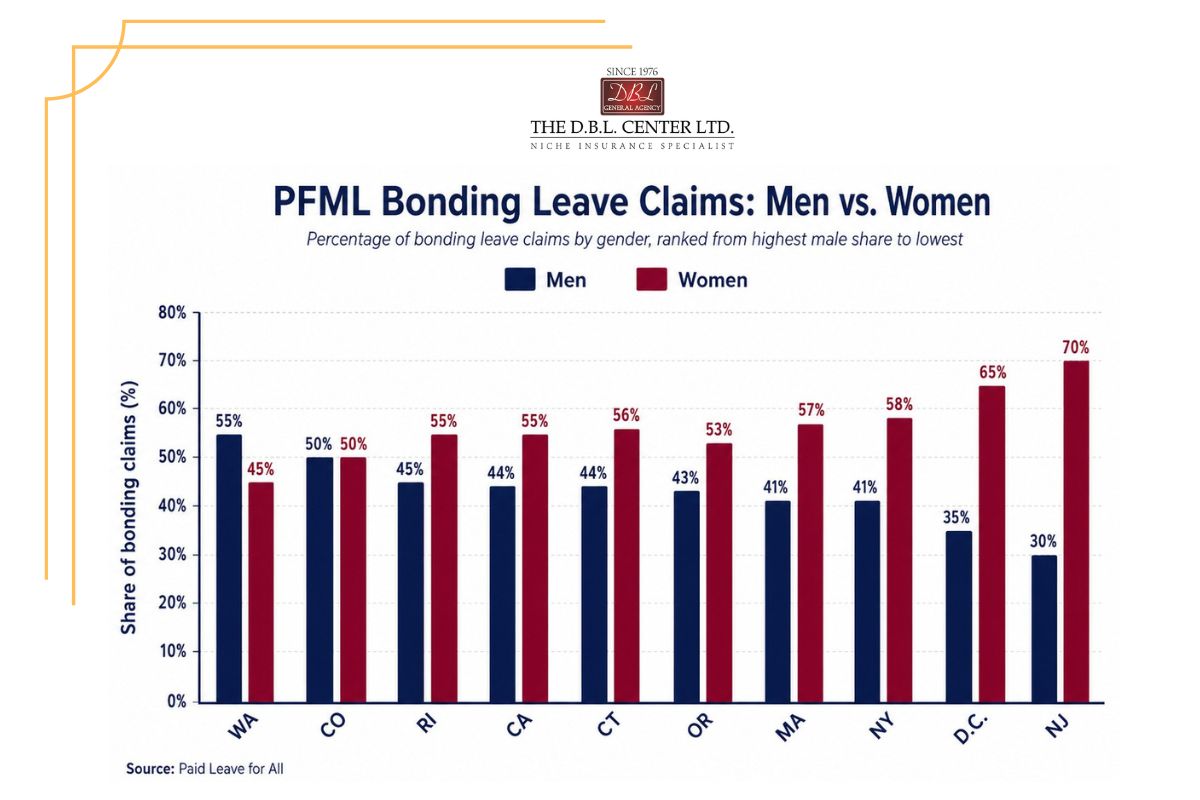
Did you know that in the state of Washington, a higher percentage of men filed PFML claims to bond with a new child than women did? More than half (55%) of bonding leave claims were from men, compared to 45% from women.
In Colorado, it was an even 50-50 split, according to recent data collected by the advocacy organization Paid Leave For All.
In New York, men made up 41% of bonding leave claims in recent years.

It’s time to stop thinking of paid family leave as maternity leave and remember that the benefit is available in a growing number of states for all parents of infants, newly adopted or new foster children within the first year.
However, claim rates aren’t equal for men and women across all states. For instance, men made only 35% of bonding leave claims in D.C. and only 30% in New Jersey.
Claim rates don’t seem to be dependent on the length of time mandated PFML / PFL has been in place. California has had PFL since 2004, and men make 44% of the bonding claims, which is the same percentage as Connecticut, which introduced its program in 2022. New York, where PFL went into full effect in 2018, has the same claim rate for men as Massachusetts, which introduced PFML in 2021.
This shows valuable opportunities for brokers to help employers educate workers on the benefits available and how to file claims before a life event occurs. In all states that offer private plan options for PFML, it’s important for brokers to let employers know that this benefit isn’t just about compliance. It’s an in-demand, necessary benefit that many of today’s employees expect.
As Father’s Day approaches, it’s a good time to talk about the ways Paid Family and Medical Leave (PFML) programs operate as broad-based benefits to help the entire workforce, not just specific demographics.
The Importance of Bonding Leave for All Parents
When fathers have time to bond with their infants, it lays the groundwork for a closer paternal relationship throughout the child’s life. When fathers take at least two weeks leave, their children later report better communication with the father, according to a paper from the Council on Contemporary Families.
Paternity leave, or bonding leave for fathers, also helps new moms. One study by Northwestern University and the Ann & Robert H. Lurie Children’s Hospital of Chicago found that moms breastfed longer when dads took at least two weeks leave. With support around the home and help with other children, moms who choose to nurse can focus on this important, and often difficult, task.
Delaying Daycare Through Strategic Leave for Both Parents
When parents claim paid bonding leave strategically, it can help delay the need for daycare and keep the infant home longer.
In New York, for example, the mother can take disability leave and then PFL for several months. She can’t claim these benefits concurrently, but she may be able to take them one after another in New York to extend the time off. However, rules in other states vary.
In New York and many other states with paid leave benefits, the father can take paid bonding leave for up to 12 weeks. By having parents take bonding leave one after each other, rather than together, the infant won’t have to enter daycare until 6 months or so, depending on the state’s paid leave duration. This can dramatically reduce childcare costs while strengthening the father’s relationship with the child.
While there are pros and cons to early daycare as well as to keeping infants home, the costs of daycare are reason alone to delay enrollment, especially if paid leave benefits replace a good percentage of the parent’s wages. (See which states have the best PFML benefits here.)
How Paid Leave Benefits Mental Health
When a father can take paternity leave, studies show it may also help postpartum depression in the mom. After all, having a second adult to lighten the load during those early months will help the birthing parent feel more support so they can focus on what’s most important: healing their body and caring for the baby.
How Paid Leave Can Address Pay Inequality
Research shows that paid bonding leave for fathers may change perceptions around caregiving duties and who is the “primary parent.”
A research paper published by the Rockefeller Institute of Government pointed out that nearly 60% of women are the primary caregiver in US households. Even when the mother works, she’s more likely to pick up what the Rockefeller Institute called the “second shift,” essentially operating as household CEO to manage calendars, housework, and meal-planning.
This, in turn, leads to more women taking lower paying roles that provide more flexibility. They might also be more inclined to take time off work and less likely to “pursue promotional tracks” in their career, according to the Rockefeller Institute.
Normalizing fathers taking paid leave to care for and bond with their child can play a role in addressing pay inequality. By laying the groundwork early that men can, and perhaps, should, play an equal role in childrearing, it sets the stage for them to play a larger role in the “second shift” of family life. This may eventually help bridge the gender pay gap by shifting societal norms and perceptions.
Why Private Plans Matter When It Comes to PFML
State-mandated PFML plans have many facets. Bonding is just one element, but it’s important to make employees aware that time off is available and encouraged.
When you help your clients write paid family leave through a private plan with The DBL Center as your insurance wholesaler, we provide the service your clients deserve.
We operate as your white-glove, white-label back-office staff to navigate this rapidly changing landscape and help ensure your clients are in compliance with new and upcoming laws across the US.