
Paid family leave isn’t just for new mothers – but other caregivers aren’t using it as much as they could.
As more states adopt paid family and medical leave (PFML) laws, the insurance industry gains important insights into who is claiming the benefit and the reasons for leave.
In general, PFML (or paid family leave (PFL) in New York, with short-term disability, often called DBL, as a separate benefit) claims fall into one of three buckets:
- Bonding with a new infant or adopted or foster child within the first 12 months
- Caregiving (for family members, which often includes aging parents)
- Medical leave (to care for the employee’s own medical condition, which may include recovery after childbirth, but also encompasses any non-job-related injury or illness)
There are other reasons, including military exigency or domestic violence, which have significantly fewer claims, and were not tracked in the research report we reviewed based on recent data from the organization New America, a non-profit, non-partisan think tank.

Understanding who takes paid family leave and why can help you serve your customers not just with private PFML programs that ensure compliance, but with ancillary benefits designed to serve the needs of the entire workforce.
Paid Family Leave by the Numbers
New America analyzed nine states and the District of Columbia based on data collected between 2023 and May 2026. The research didn’t differentiate between private or state plans.
That is to say: The data wasn’t perfect. But it reveals a clear pattern insurance brokers will find useful.
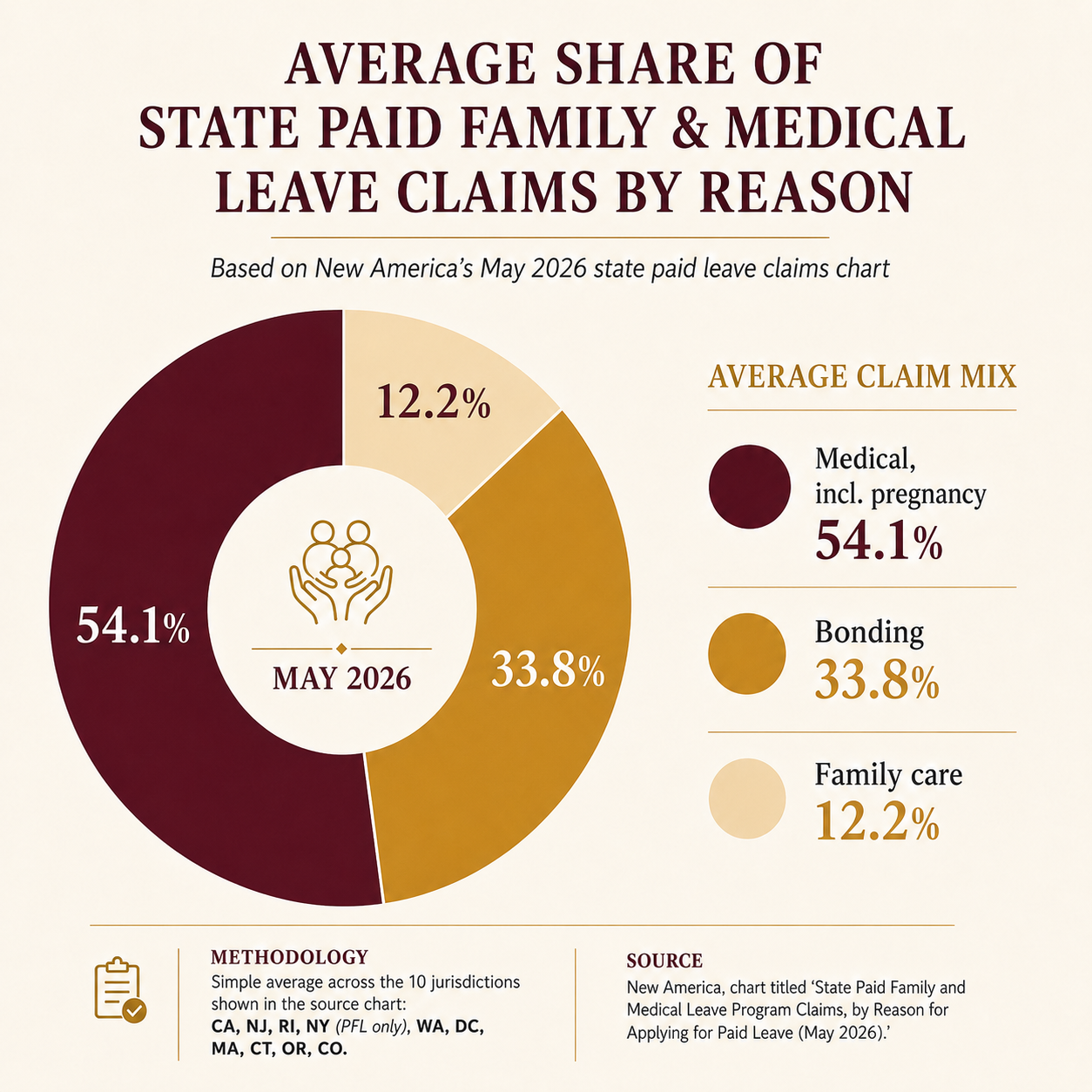
Across these states and Washington D.C., 54.1% of all claims were related to medical reasons, which included pregnancy. Medical leave represented the largest share of claims in eight of the nine jurisdictions that reported medical claims. Washington, D.C., was the exception, while New York did not report comparable medical-claim data.
More than one-third (33.8%) of claims were related to bonding, and included claims by any birth, adoptive or foster parents, regardless of gender. Previously reported research showed that mothers claim bonding leave slightly more frequently than fathers, but in some states, there’s a close to 50-50 split.
The smallest percent of claims recorded, 12.2%, were for family care, which includes caring for children, spouses, aging parents, or, in some cases, anyone who is a “family member or like a family member” with a serious health condition).
Still, this research gives us a broad understanding:
- The lion’s share of claims are made for medical reasons.
- Some working parents are taking advantage of bonding leave, since it represents more than one-third of all claims in the states analyzed.
- Proportionate to the number of caregivers in the US, (25% of all Americans, according to some studies) it seems working caregivers aren’t accessing paid family leave.
Why Is Caregiving Leave So Underutilized?
The low percentage of family-care claims does not appear to reflect a lack of need.
AARP and the National Alliance for Caregiving estimate that 63 million Americans, nearly one in four adults, provided ongoing care for an adult or a child with a serious medical condition or disability in 2025.
Most caregivers are also employed, and many report that caregiving disrupts their work schedules, finances and health.
Yet family care represented just 12.2% of the average paid family leave claim mix in the New America data.
New America suggested several possible reasons for the gap. Employees may not know the benefit is available. Waiting periods may discourage short claims.
Caregiving may also occur in increments so small (a few hours off for a doctor’s appointment, for example) that applying for leave seems more difficult than using PTO, rearranging work hours or trying to manage both responsibilities at once. The rapid increase in shorter paid leave laws such as paid sick leave and/or paid time off laws that impact 21 states plus DC can sometimes give workers the time off they need without insurance claims.
Unlike recovery from surgery, caregiving does not always happen in one predictable block of time. An employee may need a few hours to take a parent to a medical appointment, another afternoon to meet with a home health aide and several unexpected days when a care plan falls apart.
Employees may not recognize those interruptions as a reason to apply for PFML. They may also worry about how taking leave could affect their careers.
The Unspoken Costs of Caregiving on the Sandwich Generation
LegalShield research involving more than 1,100 working adults in the Sandwich Generation found that nearly two-thirds spent six or more work hours per month handling caregiving responsibilities during the workday.
Half said they discussed caregiving with their employers only when necessary or kept it quiet because they feared the effect on their careers.
The costs reach far beyond a few missed hours of work. More than half of the workers surveyed by LegalShield had spent at least $5,000 of their own money on a parent’s care during the prior year. Nearly 40% reduced savings or retirement contributions, more than one-third took on credit card debt and more than one-quarter withdrew money from retirement accounts.
AARP research also found that caregivers frequently reduce their hours, turn down promotions, temporarily leave the workforce or change employers to meet their responsibilities.
Paid family leave doesn’t eliminate every financial or emotional burden of caregiving. But, especially in states that allow incremental claims, it can give employees time to address urgent needs without losing their entire paycheck.
Benefits for the Entire Workforce
PFML should be viewed as one part of a broader benefits package designed to protect employees and their families.
Dental and vision coverage provide benefits employees can use routinely. Group life and AD&D insurance can offer financial protection following a serious accident or death. Disability, accident and critical illness products may help address income gaps and out-of-pocket expenses when an employee faces a medical crisis.
These benefits can also support recruitment and retention. Employees may join a company for salary, but a strong benefits package can influence whether they remain when life gets complicated.
The claims data also creates an opportunity for brokers and employers to improve employee education. A family-care benefit can’t help employees who don’t realize they qualify or who believe paid family leave is only available to new parents.
As the population ages and more employees find themselves caring for both children and parents, family caregiving will become increasingly difficult for employers to ignore.
The DBL Center can help insurance brokers navigate mandated paid family-leave benefits and build ancillary benefits packages that serve employees throughout their working lives.